Iran Clash Tests NPT Consensus as Treaty Review Opens at U.N.
New York- Homeland News- From
“Clear Voices. Global Impact”
News & Media Production
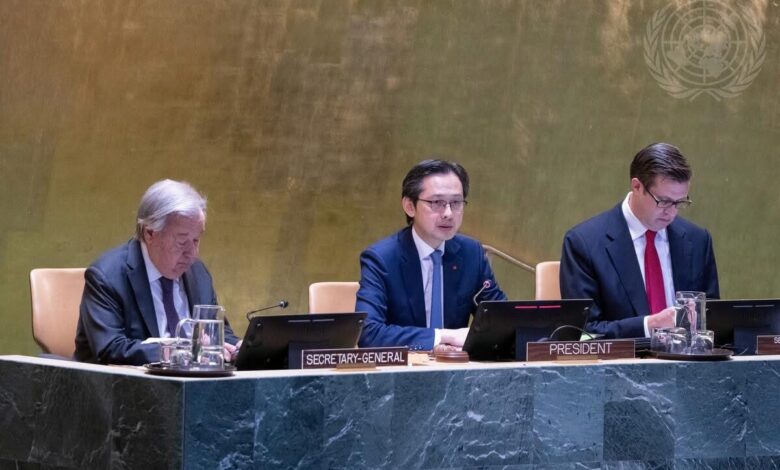
U.N. Secretary-General António Guterres and Ambassador Do Hung Viet open the 2026 NPT Review Conference at U.N. headquarters in New York amid rising nuclear tensions.| UNPhoto/Eskinder Debebe
By Ahmed Fathi
UNHQ, New York: The 2026 Review Conference of the Treaty on the Non-Proliferation of Nuclear Weapons (NPT) opened Monday at U.N. headquarters with warnings that the world is drifting back toward nuclear danger, before an early clash over Iran’s leadership role exposed the fragile politics beneath the treaty’s language of consensus.
U.N. Secretary-General António Guterres warned delegates against what amounted to a dangerous loss of memory about the nuclear age. He recalled a time when children were taught to hide under desks, shelters were built against nuclear attack and nuclear testing devastated communities and environments. That memory, he suggested, is fading just as nuclear threats, arms racing and mistrust are returning.
Guterres called on states to fulfill their NPT obligations, strengthen safeguards, prevent nuclear war and adapt the treaty to new risks, including artificial intelligence and quantum computing. His message was direct: the world cannot afford to sleepwalk back into nuclear danger.
Ambassador Do Hung Viet of Viet Nam, president of the 11th Review Conference, opened with his own warning. He said global military spending is reaching record levels, nuclear arsenals are being modernized and expanded, arms control arrangements are weakening and the idea of using nuclear weapons is no longer confined to the worst-case imagination of diplomats and military planners. He also reminded delegates that NPT states parties have not agreed on a consensus final document since 2010.
“This is not just another conference,” Viet told delegates, warning that success or failure would carry consequences beyond the walls of the United Nations and beyond the next five years.
But the first real test came not over disarmament language or a final document. It came over Iran.
The United States objected to Iran’s election as one of the vice presidents of the conference, saying Tehran’s record on safeguards and cooperation with the International Atomic Energy Agency made it unfit for a leadership role in a meeting charged with protecting the treaty. Washington accused Iran of disregarding its treaty obligations, failing to cooperate fully with the IAEA and advancing uranium enrichment far beyond what it described as any credible civilian need.
Australia backed the U.S. objection, saying Iran had not cooperated with the IAEA and had not respected its safeguards obligations. The United Kingdom, speaking for France, Germany and the UK, also placed concern on the record over Iran’s election to the conference leadership.
The United Arab Emirates delivered one of the sharpest regional objections. It said Iran’s behavior undermined the credibility of the review conference, accusing Tehran of obstructing verification, destabilizing the region, threatening freedom of navigation and seeking to use the Strait of Hormuz as a tool of economic coercion.
Iran rejected the accusations, calling them politically motivated and aimed at manipulating the proceedings. Tehran accused Washington of double standards, pointing to the U.S. withdrawal from the 2015 nuclear agreement, U.S. nuclear modernization, support for Israel and what it described as attacks against safeguarded Iranian nuclear facilities. Iran also disassociated itself from the election of the United States and Australia as vice presidents.
Russia then pushed back against the public targeting of Iran, warning against politicizing the conference on its first day. Moscow said concerns should be handled through the general debate and main committees, not through political attacks against one state party.
The dispute did not go to a vote. Instead, objecting states were allowed to record their disassociation, preserving the NPT’s long-standing consensus practice while leaving the political wound open.
That question followed Viet into the press room.
At a press conference later Monday, ATN News asked Viet why Iran’s candidacy had not been defused earlier after months of consultations with nuclear capitals, regional groups and states parties, especially given the explosive political climate after the 2025 conflict involving Iran.
Viet said Iran had been nominated by the Non-Aligned Movement months earlier as part of a slate of candidates for vice president, but that concerns over its candidacy emerged only about a week before the conference opened. He said the rules allow states to call for a vote, including by secret ballot, but NPT review conferences have never voted on procedural or substantive issues.
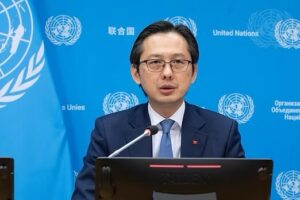
mbassador Do Hung Viet of Viet Nam, president of the 2026 NPT Review Conference, briefs reporters at U.N. headquarters after an opening-day dispute over Iran tested the treaty’s consensus tradition.| UN Photo/Eskinder Debebe
Viet said he worked, with the support of many states parties, to avoid a vote because it could have created a precedent damaging to the treaty’s consensus-based process. Instead, states agreed to disassociate themselves from the decision.
That answer captured the central dilemma of the conference. The NPT needs consensus to speak with authority. But consensus can also become a diplomatic pressure valve, allowing states to avoid rupture without resolving the dispute underneath.
Viet did not pretend the treaty is in calm waters. He told reporters the NPT regime is facing one of the most difficult moments in its history and said the relevance and credibility of the treaty are at stake. He noted that the last two review conferences failed to reach consensus on an outcome document and said this meeting must work toward practical, concrete steps to reinforce implementation.
Asked whether a conference without an agreed outcome could still be considered a success, Viet said a consensus outcome document remains the clearest expression of agreement among states parties. A third consecutive failure, he warned, would send a deeply troubling message about the credibility and strength of the NPT regime.
The NPT, which entered into force in 1970, rests on three pillars: non-proliferation, nuclear disarmament and peaceful uses of nuclear energy. It remains the core legal framework for limiting the spread of nuclear weapons. But Monday’s opening showed how much pressure now sits on each pillar.
Nuclear-weapon states are modernizing arsenals. Arms control agreements are weakening. North Korea remains outside the treaty and continues to develop its nuclear program. Iran remains at the center of a deep safeguards and enrichment dispute. Russia’s war in Ukraine has returned nuclear threats and the safety of nuclear facilities to the center of international security. The Middle East remains haunted by the unfulfilled 1995 resolution on a zone free of nuclear weapons and other weapons of mass destruction.
In the general debate, Ukraine and its supporters condemned Russia’s war, nuclear rhetoric and occupation of the Zaporizhzhia nuclear power plant. France and the Nordic countries raised concerns over Russia, China, Iran and North Korea. Australia defended transparency around its AUKUS nuclear-powered submarine program, saying it is working with the IAEA to ensure the program strengthens the non-proliferation system. Kazakhstan and Central Asian states pointed to nuclear-weapon-free zones as a practical model, while developing countries stressed their right to peaceful nuclear technology for health, agriculture, energy and development.
For now, the conference avoided a procedural rupture over Iran. It did not resolve the political rupture that produced it.
The NPT opened under the familiar language of consensus. By the end of the first day, that consensus had already been tested by mistrust, war, double standards and nuclear anxiety. The treaty survived its first clash. Whether it can survive four weeks of diplomacy in a world increasingly tempted by deterrence over restraint is now the real test.