A new, escalating humanitarian crisis. The region Pakistan has named “Azad Jammu and Kashmir” (meaning “Free” Jammu and Kashmir) is suffering.
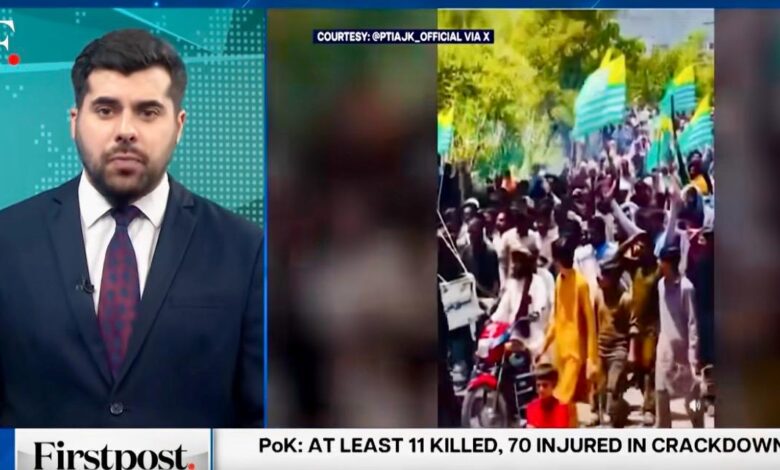
Homeland News – First- Post
Jammu and Kashmir — is in the grip of a severe and widening humanitarian crisis. Since early June 2026, Pakistani security
forces have carried out a brutal
military crackdown against unarmed civilians and peaceful protesters in Pakistan-occupied Jammu & Kashmir (PoJK), leaving dozens dead, hundreds injured, thousands arrested, and an entire region cut off from the world behind an internet blackout. The crisis has drawn condemnation from Amnesty International, the International Human Rights Foundation (IHRF), nearly 50 British Members of Parliament, and diaspora communities across the United Kingdom, Europe, Canada, and the United States.
Background: A Territory in Perpetual Subjugation
PoJK— administered by Pakistan under the label “Azad Jammu and Kashmir” (AJK) — occupies a constitutionally ambiguous space. Carved out following the first India-Pakistan war of 1947–48, it was nominally declared “self-governing,” with its own prime minister and legislative assembly. In practice, however, real sovereign authority has always rested with Islamabad, with the Pakistani Army and the Inter-Services Intelligence (ISI) exercising decisive control over the territory’s political and administrative life.
For decades, residents of PoJK have faced restricted freedom of expression, a controlled press, weak governance, economic underdevelopment, and financial dependence on Islamabad. The territory has been described by observers as “one of the most closed territories in the world” prior to the 2005 earthquake.
The Spark: JAAC and the 38-Point Charter
At the heart of the 2026 crisis is the Jammu Kashmir Joint Awami Action Committee (JKJAAC, or JAAC) — a grassroots civil society alliance that has spearheaded a popular reform movement in the region. By September 2025, JAAC had compiled a 38-point Charter of Demands encompassing economic relief and sweeping political reforms:
● Lower electricity tariffs, priced off the actual cost of production at the Mangla Dam
● Subsidized wheat prices for ordinary citizens
● A greater share of revenue from local hydropower projects
● Abolition of elite privileges and a smaller cabinet
● Removal of 12 assembly seats reserved for Kashmiri refugees settled in mainland Pakistan — a constituency that critics say is used by Islamabad to maintain political control over the territory
The 12 “refugee seats” controversy is particularly significant. These seats in the 45-member Legislative Assembly are filled not by PoJK residents but by voters scattered across Punjab, Sindh, and beyond — refugees from the wars of 1947, 1965, and 1971. Critics argue these seat-holders, who have never lived in PoJK, routinely become kingmakers in Muzaffarabad, drawing government salaries and development funds while diverting them outside the territory.
In October 2025, at least 9 civilians and 3 police officers were killed in violent clashes between security forces and JAAC protesters. On October 4, 2025, the Pakistani and PoJK governments signed the Muzaffarabad Agreement, formally committing to implement JAAC’s core demands within three months. By April 2026, the vast majority of those commitments remained unfulfilled.
The Crackdown: June 2026
With elections in PoJK scheduled for July 27, 2026, JAAC announced a Long March to Muzaffarabad for June 9 after the government failed to honor the Muzaffarabad Agreement. On June 5, 2026, authorities responded by officially proscribing the JAAC under the Anti-Terrorism Act — branding a peaceful civil rights coalition as a terrorist organization.
Hours after the ban, security forces fatally shot Shahzeb Habib, a JAAC activist, near the Barmang Bridge in Rawalakot, after stopping a vehicle carrying JAAC members at a security checkpoint. The killing immediately inflamed tensions across the region. The government simultaneously placed bounties of one crore rupees on prominent civic leaders and initiated sedition proceedings against them.
Following Shahzeb Habib’s killing, thousands of grieving citizens gathered peacefully outside a hospital morgue in Rawalakot. Heavily armed security forces opened fire on the unarmed mourners with live ammunition, killing multiple people. Dozens more were arrested as they sought medical treatment for the wounded.
Clashes in Rawalakot on June 7 and 8 left at least 11 more people dead and over 70 injured, according to official figures. Independent reports and footage circulating on social media pointed to numbers significantly higher — with some estimates exceeding 500 deaths, though these could not be independently verified due to the communications blackout. To conceal its operations, the Pakistani state imposed a total internet and mobile network shutdown across PoJK beginning June 5. By June 17, the shutdown had entered its twelfth consecutive day.
Amnesty International stated that the blackout had created an “information blackout” preventing residents from accessing services, communicating freely, or documenting human rights abuses. Amnesty formally declared: “Blanket or total internet cuts are inherently disproportionate under international human rights law and must never be imposed.”
Beyond the digital blackout, activists reported a physical blockade at key entry points into the region, cutting off supplies of food and medicines. PoJK activist Amjad Ayub Mirza, speaking from Scotland on July 2, stated that Pakistan had “disallowed food from entering
PoJK, deepening the existing crisis.”
In a disturbing development, the Combined Military Hospital (CMH) in Rawalakot came under complete military control. Families arriving to claim the bodies of the dead were reportedly forced to sign declarations identifying their deceased relatives as “terrorists” — a precondition for receiving the bodies. Those injured in protests who sought medical care were reportedly “picked up and made to disappear” upon entering hospitals or first-aid centers.
The International Human Rights Foundation (IHRF) documented the deaths of more than 32 civilians between June 8 and June 16 alone. JAAC leader Shaukat Nawaz Mir was among those arrested. Over 600 workers and activists of the JAAC have been detained as of early July 2026.
A Pattern of Repression: Timeline of Incidents
This is not an isolated episode. A documented pattern of state violence stretches back years.
● May 2024: During protests over inflated flour prices and electricity bills, Pakistani security forces opened fire — 4 protesters killed, over 100 injured in Muzaffarabad
● September–October 2025: At least 9 civilians and 3 police officers killed during JAAC-led protests; more than 200 injured. The Muzaffarabad Agreement was subsequently signed.
● June 2026: The current crisis — the most severe to date — with dozens confirmed dead, the JAAC designated a terrorist organization, a total communications blackout, and a food and medicine blockade.
International Condemnation
Amnesty International condemned the crackdown as a “violent and sweeping” action that included an internet shutdown, mass arbitrary arrests, and the deadly use of force. It called the “terrorism” designation of JKJAAC “a dangerous escalation” and said branding a grassroots organization as terrorist while cutting the region off from the outside world raised serious concerns about the authorities’ disregard for human rights. Amnesty also criticized the ban on JKJAAC as a “disproportionate attack on freedom of association and peaceful political activism.”
International Human Rights Foundation (IHRF) condemned the crackdown and called on Pakistan to: immediately halt the use of force against protesters; restore internet and mobile services; release all arbitrarily detained individuals; revoke the ban on JKJAAC; and allow an independent international investigation into reported civilian deaths.
Nearly 50 British Members of Parliament wrote formally to the UK Foreign Office seeking diplomatic intervention, citing reports of communication blackouts, mass arrests, and rising tensions. Dozens of MPs supported an Early Day Motion in the UK Parliament expressing concern about restrictions on peaceful assembly and the detention of protesters. UK Home Secretary Yvette Cooper was urged to press for de-escalation and restoration of communications.
International Diaspora Protests
The Kashmiri diaspora organized demonstrations across London, Birmingham, Bradford, and other UK cities. On June 9, 2026, diaspora members protested outside the Pakistani Consulate in Bradford, accusing Pakistani authorities of excessive force. A mass protest in London was called for July 5, 2026 — a date that Pakistan officially observes as “Kashmir Solidarity Day,” but which activists declared would now be observed against Pakistan. Thousands were expected to attend.
On June 19, 2026, members of the Kashmiri diaspora in Belgium staged a protest outside the European Parliament in Brussels, carrying banners reading “Stop human rights violations in PoJK,” “Return the bodies to their families,” and “Europe must hear.” Formal written appeals were directed to the United Nations Human Rights Council by diaspora organizations including the South Asia Peace Forum, Canada.
Kashmiri diaspora organizations and human rights groups in the United States also raised alarms, with demonstrations reported in multiple American cities condemning Pakistan’s military crackdown and calling for greater international attention to PoJK. The situation has been described by the Jammu Kashmir Global Academic & Policy Network (JKGAPN) — a collective of academics and researchers of Kashmiri origin spanning the international diaspora — as a severe human rights emergency requiring urgent intervention.
The Deeper Context: Pakistan’s Collapsing Kashmir Narrative
Pakistan has spent decades presenting itself as the protector of Kashmiri Muslims, raising the “Kashmir cause” at the United Nations, in
bilateral forums, and at every multilateral opportunity. The events of 2026 have fundamentally undermined that narrative.
As Middle East Media Research Institute (MEMRI) noted in a June 26, 2026 analysis: the unrest in PoJK, which has run since 2023 and intensified dramatically in June 2026 resulting in numerous civilian fatalities, places Pakistan’s claim to represent Kashmiri interests “under direct scrutiny.” The people Pakistan claims to represent have repeatedly taken to the streets against the administration
Islamabad controls. Critically, the Organization of Islamic Cooperation (OIC) — which routinely issues statements on the Kashmir dispute with Pakistani input — failed to address the deaths of civilians in Muzaffarabad, Rawalakot, or Dheerkot during the 2026 crisis. Its Contact Group did not convene. Meanwhile, in Indian-administered Jammu & Kashmir, elections have been held,
democratic institutions are functioning, and the Chenab Bridge — a landmark infrastructure project — was inaugurated in June 2025. In PoJK, a grassroots organization demanding flour subsidies was declared a terrorist group, its leaders hunted, its protesters shot, and its communications severed.
A Crisis the World Cannot Ignore
The events unfolding in Pakistan-occupied Jammu & Kashmir represent not an aberration but the culmination of decades of structural deprivation, broken promises, and authoritarian control. A civilian population that took to the streets demanding affordable bread and fair political representation has been met with live ammunition, mass arrests, a communications blackout, a food blockade, and military occupation of hospitals.
The international community’s response has been muted. The UN has not convened. Major powers have largely remained silent, their foreign policies shaped more by diplomatic and strategic interests than by the blood of the Kashmiri people.
But the diaspora has spoken. Human rights organizations have spoken. Members of Parliament have spoken. The people of PoJK — regardless of religion, with Hindus, Muslims, Sikhs, and Christians all caught in the crossfire — are speaking at great personal cost. The question now is whether the world will listen.