UN Secretary-General’s 2025 Global Travel Reflects a World in Crisis
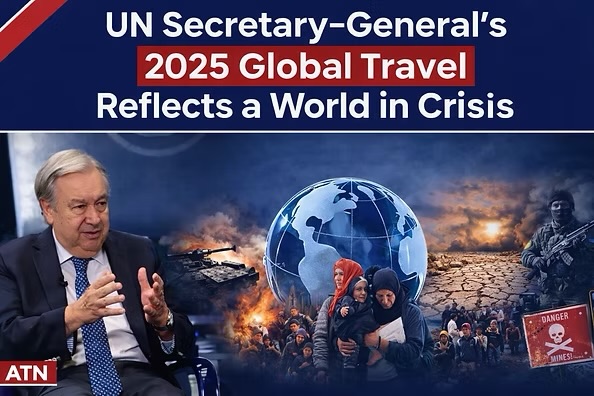
Surrounded by images of war, displacement, and climate stress, the UN Secretary-General’s 2025 travel agenda mirror a world confronting interconnected crises on multiple fronts.

By Ahmed Fathi
UNHQ, New York: The work of the United Nations rarely pauses, but in 2025 it has barely allowed its Secretary-General to stand still. A review of the official travel record of António Guterres reads less like a ceremonial diary and more like a running log of a world in sustained distress. Each destination marks a pressure point. Taken together, the pattern is unmistakable: multilateralism is no longer operating at a steady pace—it is reacting, adjusting, and at times simply trying to keep up.
From the opening days of January through the final weeks of December, the Secretary-General moved repeatedly between Europe, the Middle East, Africa, Asia, and the Pacific. These were not goodwill tours. They reflected where diplomatic engagement was most urgently needed, and where the absence of the UN’s top political voice would have carried real consequences.
Switzerland appears frequently, and not by accident. Geneva has become the operational backbone of the UN system at a moment when humanitarian needs are expanding faster than resources. Refugee crises, human rights investigations, and emergency coordination efforts increasingly converge there. Repeated visits underscore a system under financial and political strain, where sustaining basic operations now requires constant high-level attention.
The Middle East dominated much of the travel calendar. Egypt, Iraq, Saudi Arabia, Qatar, Oman, and Lebanon were all stops in a region shaped by unresolved wars, fragile ceasefires, and regional realignments. In Iraq, the Secretary-General marked the closure of the UN Assistance Mission after more than twenty years—a moment that carried both symbolic weight and strategic uncertainty.
The UN’s departure raised difficult questions about international engagement after drawdown, and about how sovereignty and stability are balanced once peacekeeping and political missions conclude.
In the Gulf, visits were quieter but no less consequential. Conversations there focused on mediation, de-escalation, and regional coordination, often away from public view. These engagements reflected a reality long understood by diplomats: the most important UN diplomacy rarely happens at the podium.
Africa’s place on the itinerary reflected a continent facing overlapping crises rather than isolated ones. Stops in Ethiopia, Angola, South Africa, and Egypt came amid conflict, climate stress, debt pressures, and political transitions. The tone of engagement has shifted. The UN is no longer framing its role primarily around long-term development benchmarks. Instead, the emphasis is on political stabilization, humanitarian access, and reinforcing cooperation with regional institutions—particularly the African Union—as African-led diplomacy takes on greater prominence.
Asia and the Pacific posed a distinct set of pressures, increasingly connected to Central Asia’s strategic reemergence. Engagements in China and Japan unfolded amid great-power competition, economic uncertainty, and stalled climate commitments. Visits to Kazakhstan and Turkmenistan highlighted the region’s growing role as a hub for energy, trade, and geopolitical balance across Eurasia.
In Southeast Asia and the Pacific—Malaysia, Viet Nam, and Papua New Guinea—the focus shifted to existential climate risk. For small island states, the Secretary-General’s presence is not symbolic; it reflects a reality in which survival itself has become a diplomatic issue.
Latin America’s prominence in the Secretary-General’s 2025 travel agenda was driven largely by Brazil, where COP30 in Belém became a defining moment for global climate diplomacy. António Guterres used the summit to issue stark warnings that breaching the 1.5°C threshold is now unavoidable, emphasizing the human cost of delay. His engagements focused on accelerating implementation, closing climate finance gaps, protecting forests, and reinforcing accountability across governments, financial institutions, and major emitters.
What gives this travel record added significance is the internal condition of the UN itself. Throughout 2025, the organization grappled with serious financial shortfalls caused by unpaid and delayed contributions. Programs were scaled back, staffing decisions were deferred, and operational uncertainty became routine. Against that backdrop, the Secretary-General’s travel took on an additional purpose: shoring up political support for an institution under visible strain.
From a UN correspondent’s perspective, the story here is not about miles logged or meetings held. It is about containment. Many of these trips aimed to prevent deterioration rather than deliver breakthroughs. Success, in this environment, is often defined by what does not happen: a conflict that does not widen, a humanitarian corridor that remains open, a diplomatic channel that does not collapse.
The map of the Secretary-General’s movements in 2025 aligns closely with the world’s fault lines. It is a record of constant intervention in a system that no longer self-corrects. In today’s global climate, diplomacy is not episodic. It is continuous, exhausting, and increasingly personal.
The message embedded in this travel schedule is blunt. Multilateralism now survives through presence, persistence, and pressure. The Secretary-General’s near-constant motion is not a preference—it is a necessity in a world that shows no sign of slowing down.