Special Report: António Guterres Acknowledges UN’s Limited Leverage Amid Global Impunity
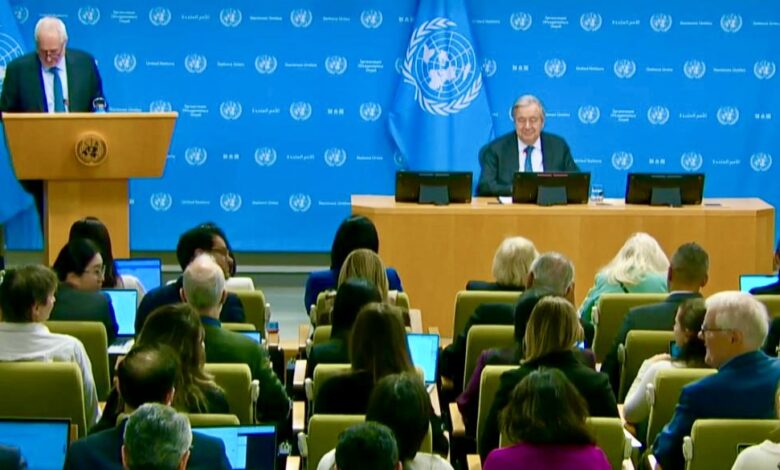
Full Video of the Press Conference by the United Nations Secretary General António Guterres
– New York – Homeland News
By: ATN News Team
Ahmed Fathi -ATN News |@UNTV
UNHQ, New York: U.N. Secretary-General António Guterres used his final annual start-of-year press conference on Thursday to draw hard legal and institutional lines around the role of the United Nations, warning that the world is entering a period of escalating disorder driven by impunity, unchecked power and the erosion of multilateral authority.
Speaking at U.N. headquarters in New York, Guterres framed 2026 as a year already defined by “surprises and chaos,” arguing that international law is increasingly ignored while the institutions created to uphold it lack the leverage to enforce compliance.
“The law of power is prevailing over the power of law,” he said. “International law is trampled. Cooperation is eroding. And multilateral institutions are under assault.”
Guterres anchored his remarks in an analogy drawn from his background in physics, invoking Newton’s Third Law — action and reaction — to argue that in geopolitics today, reactions are no longer stabilizing or predictable. Instead, reckless actions, he said, are multiplied by geopolitical divisions, inequality and a growing culture of impunity.
Global governance structures, he warned, remain “out of time,” reflecting power realities from 80 years ago even as economic influence steadily shifts toward emerging economies and South-South trade. Reform, he said, is unavoidable — but the values enshrined in the U.N. Charter are not.
That framing set the tone for a wide-ranging question-and-answer session in which journalists repeatedly tested where the United Nations draws its legal boundaries.

The atmosphere in the room carried both urgency and finality. This was Guterres’ last customary January exchange with the international press corps, and the session opened on a personal note when Valeria Robecco President of UNCA paused to salute Reuters correspondent Michelle Nichols, prompting applause for Nichols’ 14 years covering the United Nations.

Asked by Michelle Nichols of Reuters on whom he meant by warning that global problems cannot be solved by “one power calling the shots,” Guterres pointed to the United States as the world’s most powerful country and cautioned against a future divided into rival U.S.- and China-led spheres of influence. Stability, he argued, depends on a networked form of multipolarity supported by strong multilateral institutions, not unilateral dominance.

But when reporters pressed on enforcement, Guterres acknowledged the organization’s limits. Responding to Pamela Falk of U.S. News and World Report, he said the United Nations lacks the power to compel compliance by states that violate international law.
“Unfortunately, there is one thing that we miss,” he said. “It’s leverage.” A moment later, reflecting on conflicts from Gaza to Ukraine, he added quietly, “I would like to have the power to make them stop.”

That tension — legal authority without coercive force — dominated exchanges on Gaza. Edith Lederer of The Associated Press asked about concerns that President Donald Trump’s proposed “Board of Peace” could sideline the Security Council’s authority, particularly regarding Gaza.
Guterres responded by drawing a firm institutional line, stressing that only the Security Council holds Charter-mandated authority to adopt binding decisions on peace and security and to authorize the use of force. He described the current ceasefire in Gaza as a fragile “lesser fire,” saying it has reduced violence but fallen short of ending it.
A lasting solution, he said, requires full Israeli withdrawal, the decommissioning of armed groups and a credible path toward a two-state solution.

Follow-up questions from Biesan Abu Kwaik of Al Jazeera Arabic focused on settlement expansion and settler violence in the West Bank. Guterres said he is “determined” to oppose actions undermining the two-state framework, including settlements, demolitions and settler attacks, and stressed that Gaza’s future governance must be linked to the Palestinian Authority.

Accountability was raised by Ibtisam Azem of Al-Araby Al-Jadeed, who cited the killing of hundreds of UNRWA staff and Israel’s restrictions on the agency. Guterres said the United Nations has taken clear positions of condemnation, referenced relevant International Court of Justice findings, and called for accountability while insisting UNRWA will continue operating despite political pressure.
Legal red lines resurfaced in questions on self-determination. Denis of Ukraine asked whether the principle applies to Crimea and Donbas. Guterres said the U.N. Office of Legal Affairs has concluded it does not, and that Ukraine’s territorial integrity prevails.

The issue was tested again in the Middle East context when Namo Abdulla of Rudaw Media Network asked whether the international community should recognize Kurdish autonomy or self-determination in Syria, citing Kurdish forces’ role in defeating ISIS and their concerns about new power structures in Damascus.
Guterres acknowledged a long history of persecution against Syrian Kurds but rejected a military or separatist solution. The answer, he said, lies in inclusive political institutions within a unified Syrian state, not in fragmentation.
“My main objective,” he said, “is to create conditions for societies in which all components feel their rights are respected and feel that they belong to the country as a whole.”
Iran returned later in the briefing as reporters pressed on repression and accountability.

Camelia Entekhabifard of Independent Persian questioned why the Secretary-General has not publicly called for Iran to accept a fact-finding mission into protest killings. Guterres drew a clear procedural boundary, saying such investigations fall under the mandate of the Human Rights Council, not the Secretariat, while affirming that any decision by the council would have full U.N. support.

Sudan emerged as one of the starkest examples of the United Nations’ constraints. Gabriel Elizondo of Al Jazeera English asked how the organization plans to change the trajectory of what Guterres has repeatedly described as the world’s largest humanitarian crisis.
Guterres said he and envoy Ramtane Lamamra are intensifying efforts to secure temporary ceasefires and demilitarized zones to allow humanitarian access. But he warned that Sudan has become a “playground” for external actors supplying weapons and prolonging the conflict, complicating any path to peace.

Technology was one of the few areas where Guterres outlined a forward-looking initiative. Asked by Ahmed Fathi of ATN News whether the United Nations has leverage over technology companies shaping elections and conflicts, Guterres answered plainly: “We do not have leverage.”
Instead, he said, the organization is building governance tools, including a high-level scientific panel on artificial intelligence drawn from more than 2,400 candidates and an annual global dialogue aimed at establishing guardrails to preserve human agency. He reiterated his call for a $3 billion global fund to build AI capacity in developing countries.

Pressed by Nada Tawfic of the BBC on what those guardrails should include, Guterres said the central principle must be human control, opposing autonomous weapons and warning of a “massive transfer of power” from governments to private companies driven by control of data.

The session closed with questions about leadership and succession. Marta Moreira of Lusa, Portugal’s national news agency, asked whether it would be a failure if the next secretary-general is not a woman. Speaking in Portuguese, Guterres said it is “clearly time” for the United Nations — and global powers — to be led by women, while stressing that the decision rests with member states.

Asked by Arul Louis of Indo-Asian News Service about his legacy, Guterres dismissed the notion.
“I’m doing my duty,” he said. “Legacies are the appreciation of others.”
Throughout the roughly 75-minute exchange, the atmosphere in the briefing room reflected a mix of urgency and familiarity. Questions moved across regions and crises — from Gaza and the West Bank to Ukraine, Iran, Sudan and Syria — and into broader debates over self-determination, accountability, technology governance and the limits of multilateral enforcement. The tone was persistent but measured, with correspondents pressing the Secretary-General on legal authority rather than ideology. Guterres answered with a measured frankness, often pausing to spell out what the U.N. can legally do and where its authority stops, while openly acknowledging the political limits it faces — a dynamic that made clear to everyone in the room that the organization is being asked to do more in a world that is steadily narrowing its room to maneuver.