You can lead a horse to water, but you can’t make it drink.
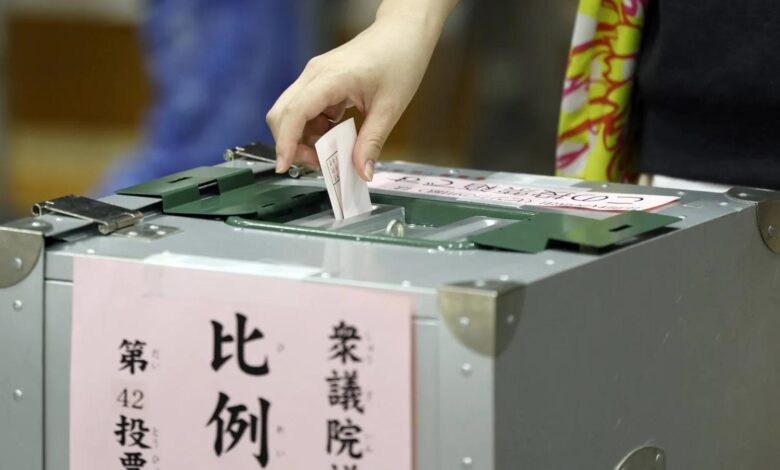
A woman casts her vote in the general election in Tokyo (EPA)
New York – Homeland News
That’s my takeaway from the
Liberal Democratic Party’s (LDP) landslide victory in last Sunday’s House of Representatives election in Japan. The more than three decades-long attempt by Japan’s “political class” to instill a viable two-party political system has ended in abject failure.
Since the LDP was formed in 1955, when two conservative parties merged, it ruled continuously until 1993. Thus, Japan was failing one of the working tests of whether a country is a democracy or not: the existence of a viable opposition and, at least sometimes, elections producing a change in government. As the bursting of the 1980s asset price bubble in the early 1990s exposed multiple failures in the Japanese economy and polity, the political class became animated by the idea that Japan needed a true two-party system and serious electoral reform to bring it about. In 1994, the voting system in the lower house, the seat of government, was changed from one of multiple (three to five) member constituencies to a parallel system of first-past-the-post single member electorates (now 289 seats) and party-list proportional representation regional blocks (now 176 seats).
The time seemed ripe. The LDP had lost its majority in the 1993 general election and went into opposition for the first time since its inception. With the LDP on the ropes and electoral reforms ostensibly aimed at weakening the grip of the LDP political factions (habatsu), surely the scene was set for a two-party political system with periodic changes in government to start to take root. Nine months later, however, the LDP was back in power, initially in coalition with its old rival, the Japan Socialist Party. Since then, the LDP has been out of power only once, from August 2009 to December 2012.
The LDP again looked on the verge of losing power when charisma-challenged Prime Minister Shigeru Ishiba led the party to two successive electoral defeats: first losing its majority (in coalition with Komeito) in the October 2024 lower house election and then losing its majority in the July 2025 upper house half election. Hopes for a two-party system to take root started to rise again.
Prime Minister Sanae Takaichi’s victory – and it is largely her victory – has put paid to that. For the first time ever, the LDP, even without its new coalition partner, the Japan Innovation Party (36 seats), has a more than two-thirds majority in the lower house: 316 seats out of 465, meaning that it can pass legislation blocked by the upper house. So sweeping was the LDP’s victory that it ceded 14 seats to opposition parties because it did not put enough candidates on its proportional representation party list! It remains to be seen what the LDP will do with its regained dominant political position, but it looks like it has secured its grip on power for another generation.
Why does the establishment of a two-party system in Japan seem like such a pipe dream? The LDP is a broad-church political party and is able to satisfy the electorate’s appetite for change by switching out leaders and producing an exciting mood-changing one every now and again: think Junichiro Koizumi, Shinzo Abe and now Sanae Takaichi.
For a two-party system to develop, a main opposition party has to form and last long enough to develop credibility with the public; but the opposition party landscape in Japan is notoriously fragmented and opposition parties form, splinter and merge with monotonous regularity. The main opposition party (the Constitutional Democratic Party of Japan) merged with the LDP’s erstwhile coalition partner (Komeito) to form the Centrist Reform Alliance at the start of the latest election campaign! And the latest incarnation of the main opposition party is the umpteenth one since Japan caught the political reform bug in the early 1990s. The new party trumpeted its centrist raison d’etre, but, at heart, the LDP is already centrist.
Such structural factors on both sides may offer compelling explanations for why more than thirty years of political reform and yearning by pundits has not produced a viable two-party system in Japan. But perhaps the best explanation is hidden in plain sight: the Japanese electorate is conservative (with a small c) and quite likes the stability of perennial LDP rule.